

- AdStock describes how the impact of an advertising campaign is prolonged and diminished over time, comprised of immediate impact, decay, and cumulative effect.
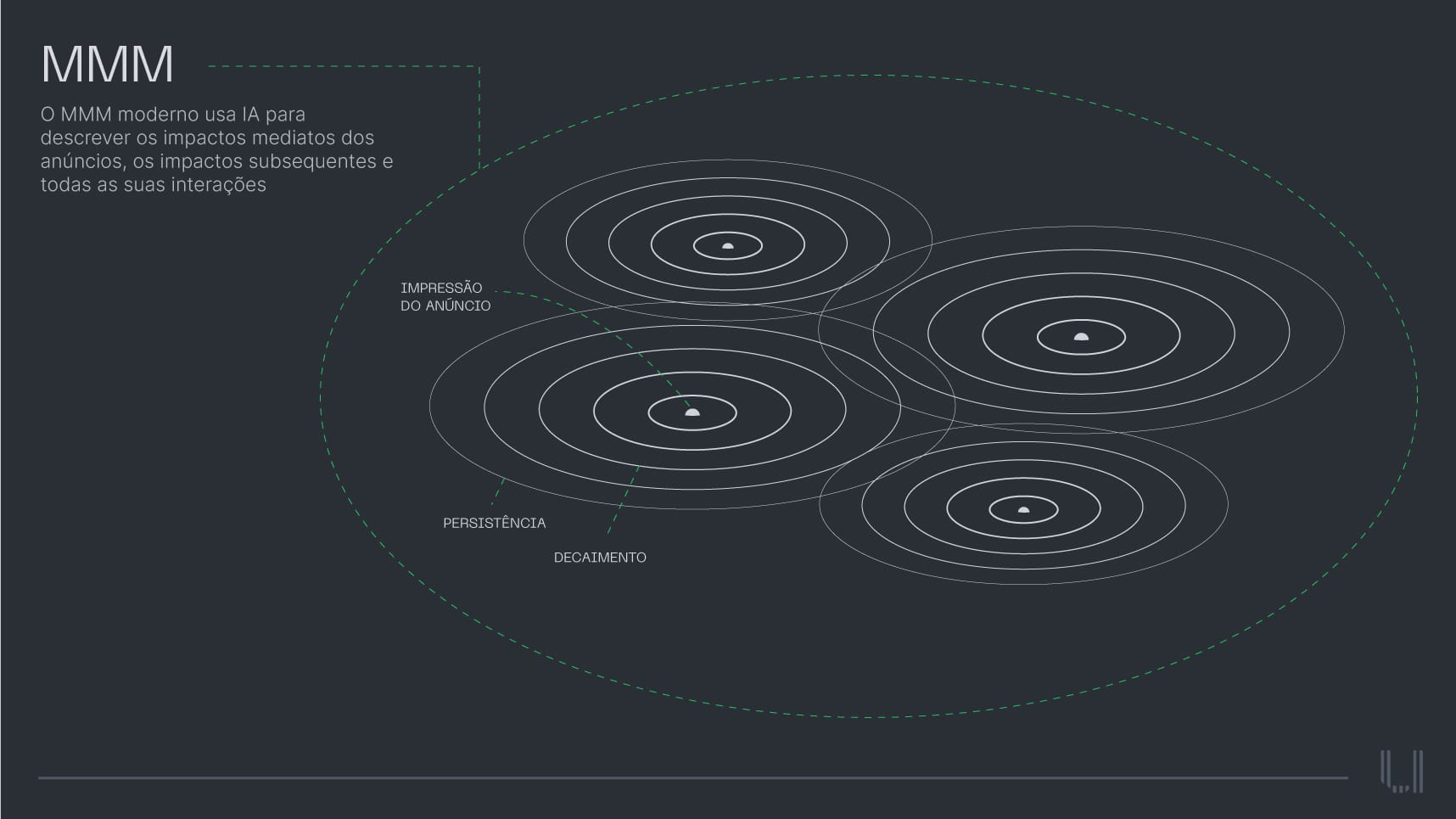
- MMM is a technique that uses historical data to quantify the impact of marketing activities on sales and other KPIs, analyzing how each marketing decision creates waves of impact on the consumer.
- The AdStock formula is used to plan long-term campaigns, optimize budgets, and evaluate the effectiveness of campaigns, also considering the concept of diminishing returns to avoid wasting resources.
Imagine a tranquil lake, its calm surface reflecting the sky like a mirror. Suddenly, a child throws a rock into the water, breaking the serenity with a sudden movement. The stone hits the surface, creating an initial wave that expands rapidly, followed by other smaller waves that propagate across the lake. This simple and beautiful phenomenon sums up the essence of one of the most interesting components of Marketing Mix Modeling (MMM), AdStock.
- Also read: Introduction to Marketing Mix Modeling (MMM)
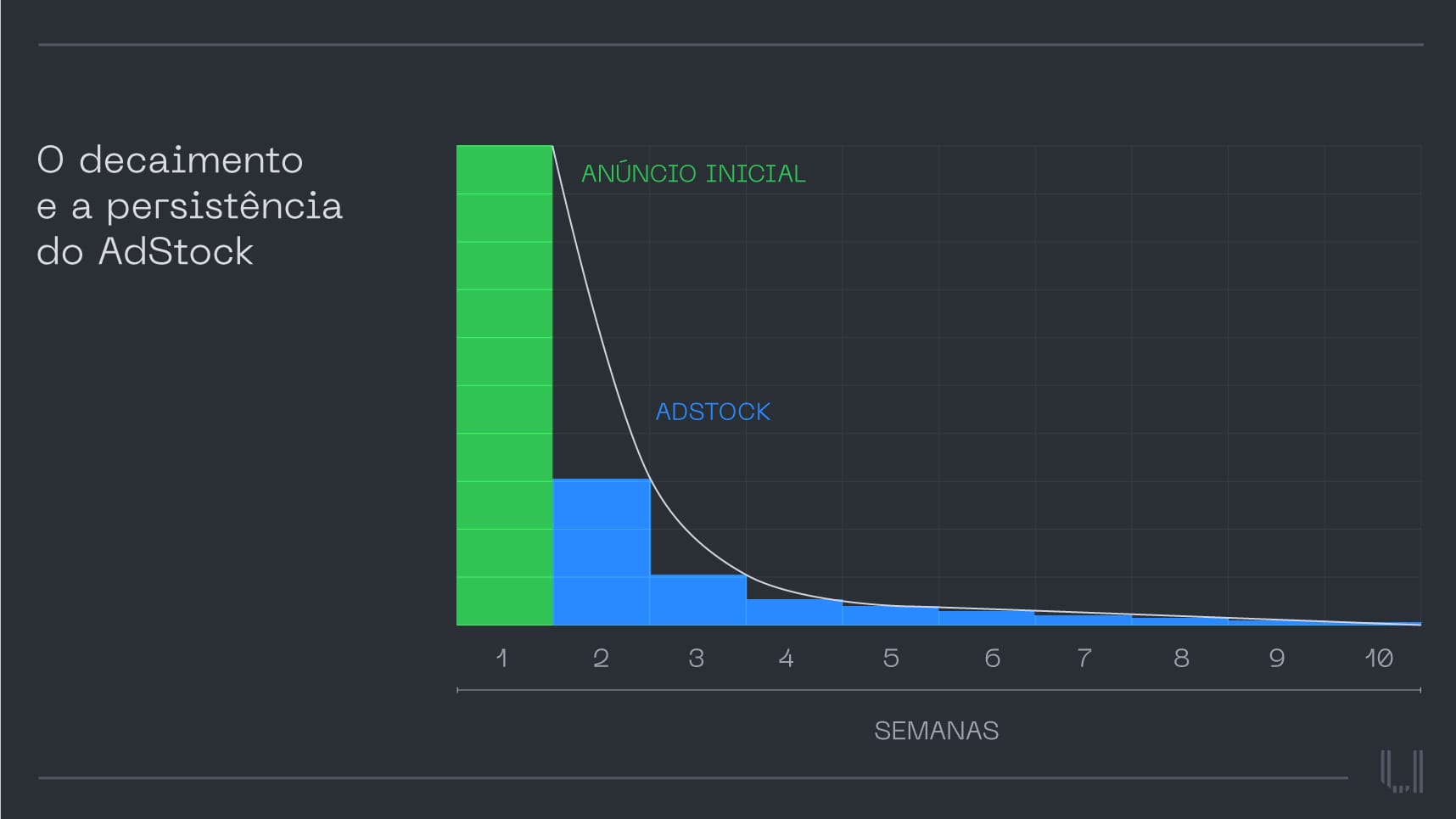
AdStock describes how the impact of a campaign is prolonged and diminished over time, being broken down into three effects:
Immediate Impact: The instant effect of an advertising campaign, which can be measured by the increase in sales or awareness shortly after exposure.
Decay: After the initial impact, the ad's effect begins to wane. This decay is generally exponential, meaning that the impact decreases rapidly at first and then more slowly over time.
Cumulative Effect: The prolonged effect of advertising, which continues to influence consumers even after the campaign has ended. This residual effect is what AdStock captures.

Like the rock in the lake, an advertising campaign launched on the market creates an immediate and significant impact. This initial wave represents the immediate increase in awareness and sales. As time goes on, subsequent waves, although smaller, continue to spread, keeping the influence of the campaign alive and present in the market. Each new wave, although less intense, is still capable of influencing consumer behavior, prolonging the initial effect of advertising.
To recap: What is Marketing Mix Modeling (MMM)?
This article is part of the Uncover Marketing Mix Modeling (MMM) Guide, so before following, it's worth going back to what an MMM is. It is an advanced analytical technique that helps companies understand the impact of various marketing activities on sales and other KPIs. Think of MMM as the science of understanding not just the stone and the first wave it creates, but all subsequent waves and their interactions.
The method captures how each marketing decision - from the choice of channel to the timing and frequency of campaigns - produces an effect on the consumer, and how these effects spread and interact in complex ways to influence the final results.
How Does Marketing Mix Modeling Work?
The MMM uses historical sales, marketing, and other external variables to build econometric models that quantify the impact of different marketing activities. Here are the key components of MMM:
- Marketing Variables: Include advertising, promotions, pricing, distribution, and other elements of the marketing mix.
- Control Variables: External factors such as seasonality, economic trends, and competitive activities.
- Econometric Modeling: Uses statistical techniques to estimate the contribution of each marketing variable to business results.
AdStock and the “physics” of its waves
Returning to our initial comparison, let's now show how AdStock works in a similar way to how physics would explain the wave generated by our stone: through its mathematical formula. The basic formula of the persistence model is:
AT = TT + αAt−1
Where:
AT Is it AdStock in time T
TT It is the value of the advertising variable over time T
λ It's the persistence parameter
A half-life (Te) is calculated as:
Te = log (λ)/log (0.5)
The formula shows that over time, the effect of advertising decreases, but does not disappear immediately. Instead, it gradually dissipates, influencing purchase decisions and brand perception on an ongoing basis.
The AdStock formula is crucial for developing assertive marketing strategies. Based on it, we can learn several practical lessons:
- Campaign Planning: Understanding the persistence of advertising effects allows companies to plan their campaigns to maximize impact over time. Instead of focusing all advertising on a short period, companies can distribute their campaigns to maintain continued influence in the market.
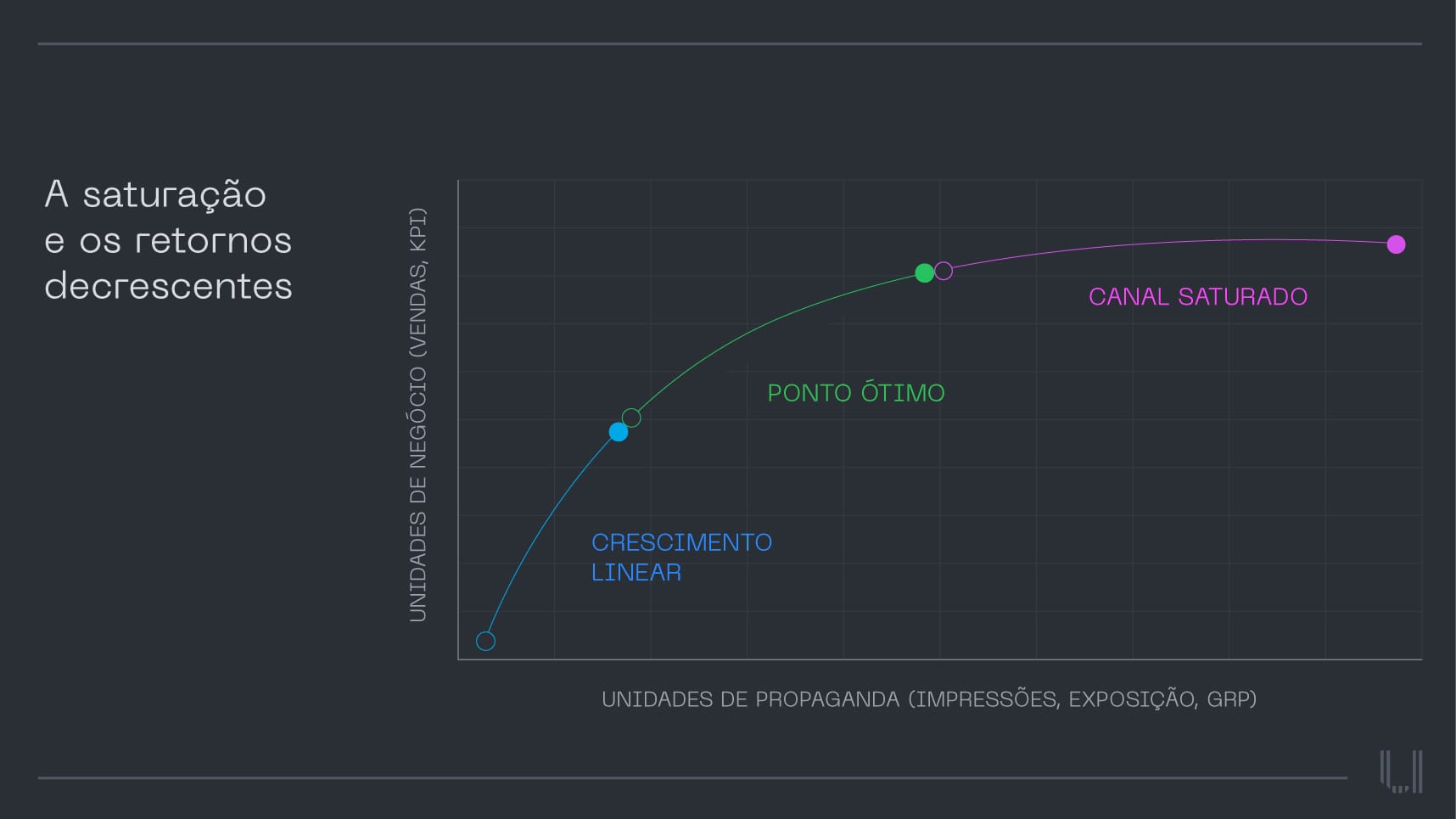
- Budget Optimization: Identifying the saturation point where returns begin to decrease helps companies avoid overspending. By measuring the half-life of AdStock, companies can determine the optimal frequency of campaigns to maintain awareness without wasting resources.
- Effectiveness Assessment: Assessing the residual effect of campaigns allows for a deeper understanding of how different types of advertising influence consumers in the long term. This helps to adjust future strategies, focusing on the types of campaigns that have the strongest residual effects.

Decreasing Returns
An important consideration when using AdStock is the concept of diminishing returns. As we increase the amount of advertising, the marginal effect on sales decreases. Announcements eventually saturate, and continuing to expose them at that point only wastes resources. It's like trying to pour more water into a bucket that's already full, making it overflow.
A common model for capturing this effect is the logarithmic transformation:
ST = α log (TT) +T
Where:
ST Are sales in time
TT Is it the level of publicity over time
α Is the response coefficient
ϵT It's the random error term
This model helps explain why continuous and overly repetitive campaigns may not be the best strategy. Instead, focusing on advertising quality and timing may be more effective.
Watch our video of ROAS Marginal to learn more about diminishing returns.
Conclusion
AdStock offers a clear view of how the memory of an advertising campaign persists, continuously influencing consumers and ensuring that each investment in advertising produces the maximum impact over time.
In the end, the key is to balance the immediate impact with the residual effect, constantly adjusting campaigns based on insights derived from AdStock. Thus, the brand resonates perpetually in the minds of consumers, at the lowest cost and with the best returns.