

- The recent decision of the STJ to prevent the purchase of words associated with competitors ended up weakening a practice that is very common among media market agents: brand defense. This practice consisted of buying words associated with the companies themselves, preventing competitors from acquiring them.
- Brand defense was motivated by economic incentives from the media market. It can be explained theoretically using game theory, a methodological framework that mathematically models agents in a competitive environment. In the simplified model proposed in the text, it is verifiable that there are incentives for companies to carry out brand defense, even if they end up spending more money than necessary (which represents an inefficient balance).
- Even though the act of brand defense has become obsolete, we discuss that there are still benefits to buying words associated with the company. Whether to defend yourself against malicious and criminal sites, or to direct potential customers to more advanced stages of the conversion funnel. However, depending on the methodology for measuring the result of this investment, it can be positively inflated and biased.
Intro
This decision decreed the weakening of a typical practice of this type of market: brand defense. In the context of search media, brand defense is when a company acquires terms and words associated with itself. In other words, it's when a company buys the word of its own name and other terms highly related to the company's branding in one of the vehicles that provide this type of media service (such as Google's Keywords).
This practice exists, among other factors, because of the interaction between competing companies in the media market. Suppose “Unc” and “Over” are competing companies. If the company “Unc” does not buy its own words on the platforms, its competitor, the company “Over”, may dominate the direction of the first link associated with the competitor's searches - in an attempt to “steal” searches. Because of this possibility, the company “Unc” would shop for words with “brand defense” in mind.
However, due to the fact that “Over” was no longer able to purchase terms associated with “Unc” due to the STJ's decision, this strategy became obsolete.
The decision acted to fix a market failure - situations in which there is an inefficient allocation of resources. This is due to the fact that, in a context of interaction between companies in which it is possible to acquire words from a competitor, investment in brand defense may exceed an ideal point. This means that companies would invest beyond a point where there is a good return on investment - generating overinvestment in unprofitable media products.
It is worth saying, however, that the practice of buying terms associated with the brand itself continues to occur, even with this prohibition. This is precisely due to other advantages that this type of strategy can bring to a media portfolio. We discuss these advantages in the third section of this text.
What motivates brand defense?
As explained before, brand defense is carried out by companies because of incentives generated by the relationship with competitors. In economic science, to explain this situation of strategic interaction between two or more agents, we use Game Theory - a framework for the theoretical modeling of these situations.
In the case of brand defense, we can create a simple model to explain the interaction of the “Unc” and “Over” companies. Consider that both companies may or may not do brand defense. Also consider that the return of brand defense is given by a hypothetical value of 10 reais - an amount that is intrinsically associated with being the first link that appears when searching for a term.
Also consider that the cost of doing trademark defense is 3 reais.
The hypotheses for the model are that when a company defends a brand (or buys words associated with the competitor), it necessarily spends 3 reais. In addition, there is an issue of exclusivity: a company can only buy its competitor's words if they haven't been bought yet - if the competitor hasn't bought it, it will seize the opportunity and buy the terms.
“Unc” and “Over” face the following situation, therefore:
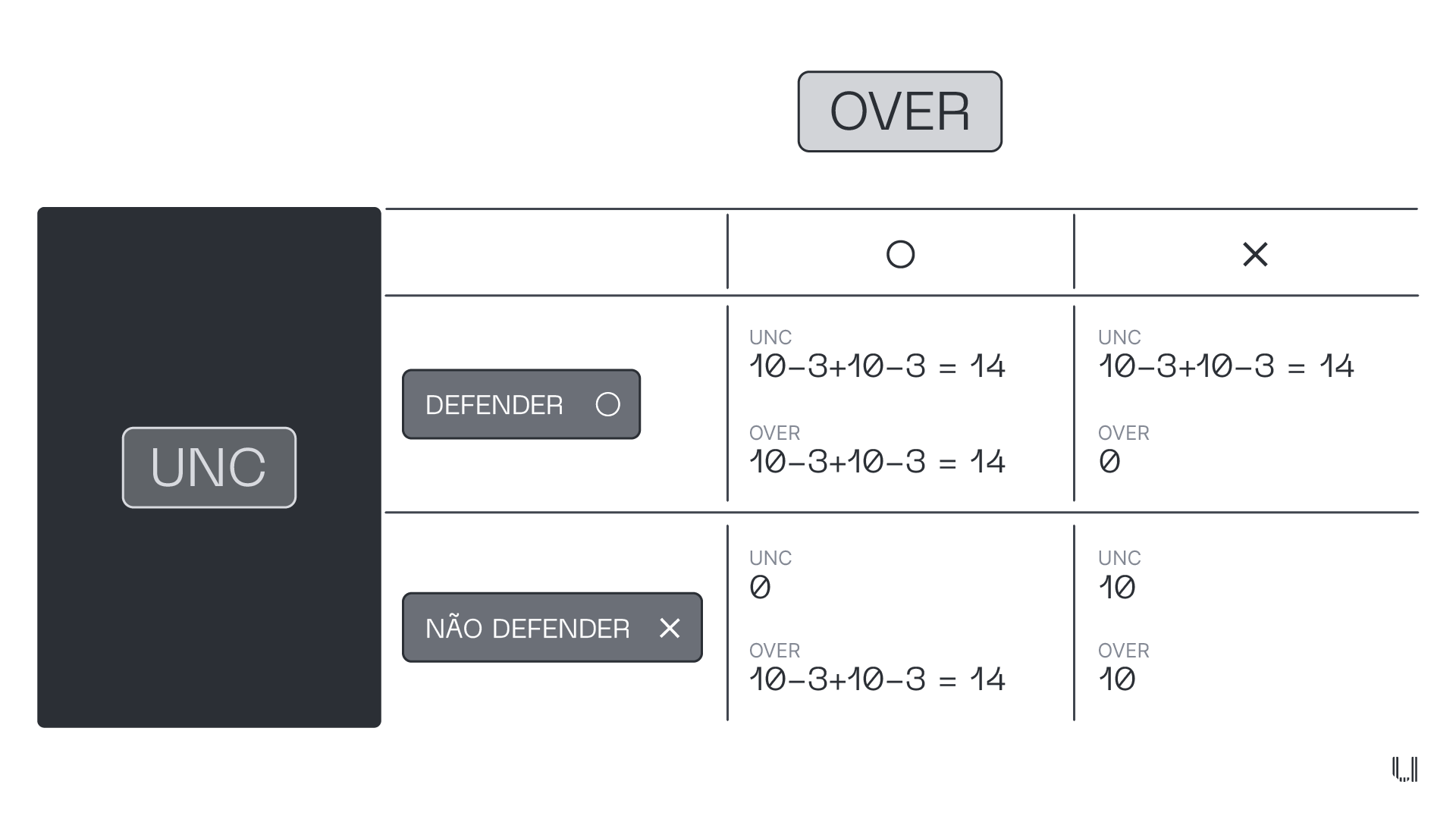
When not defending a brand, companies earn 10 (naturally they appear as the first link in the search for the brand). When defending a brand, there can be two possible results: if the other company also defends, the gain is 10 - 3 = 7; otherwise, the gain is 10 - 3 + 10 - 3 = 14 (the company buys the terms of its own brand defense and the terms of the competitor).
Both companies go through the same decision (we call this a symmetric problem), so I'm going to treat them identically. In a scenario where your competitor doesn't defend, your potential returns are: 10 - 3 + 10 - 3 = 14, if you defend the brand; 10 if you don't defend the brand. Like 10 - 3 + 10 - 3 = 14 > 10, that is, the company will defend the brand. In the scenario in which the competitor defends, her potential returns are: 10 - 3 = 7, if she defends the brand and 0 if she does not defend the brand. By hypothesis, 10 - 3 = 7 > 0, that is, the company will also defend the brand.
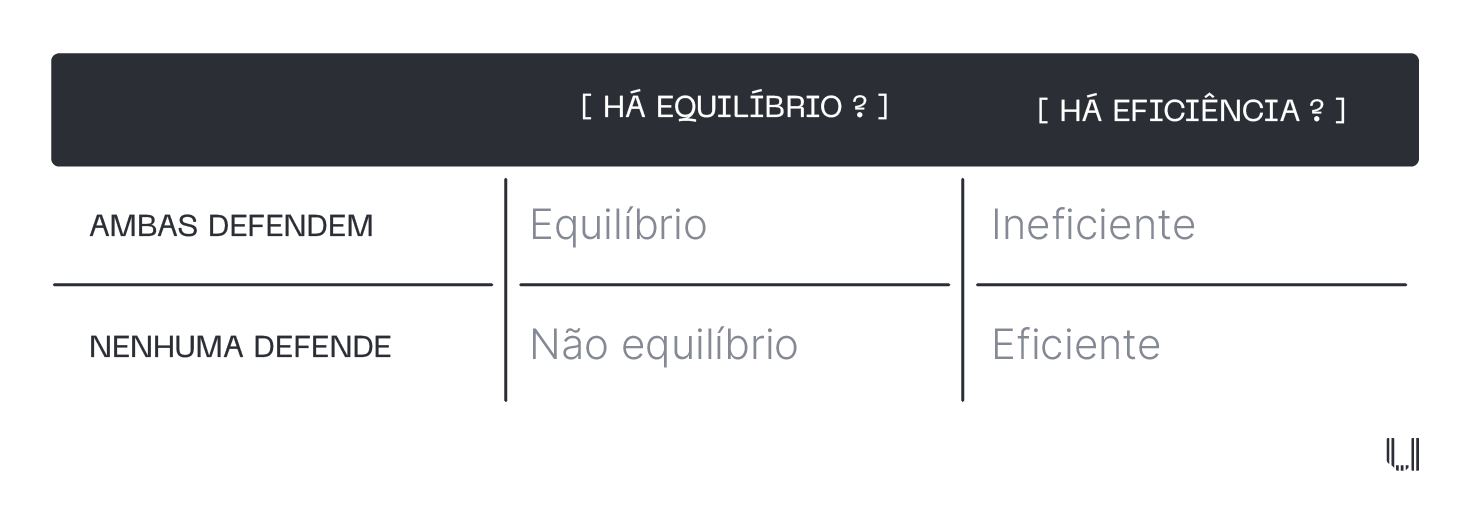
Note that in both scenarios, there is brand defense. Companies have an incentive to defend - with no incentive to stop defending. This characterizes, in Game Theory, a Nash equilibrium. A balance, in this sense, is a situation in which no agent wins by changing strategy - with every other agent involved keeping their current strategies.
However, despite the situation in which both defend being characterized as a Nash Equilibrium, we have that this balance is inefficient. This means that it is possible to improve both companies without making any of them worse (going to the case where no one defends the brand). However, this efficient situation would not be characterized as balance - there would be an incentive for both companies to “deviate” and buy terms associated with competition. This “market failure” generates excessive media spending - hence the inefficiency. The STJ's decision to prohibit the purchase of competing terms, mentioned above in the text, served to correct this market failure.
Effects and discussions of the STJ decision
The STJ's decision to bar the purchase of terms from competitors acted to correct a market failure - in the situation where the practice was allowed, companies would spend beyond what was great/efficient. It is worth saying that in this case, without state intervention, this problem would not be solved on its own. Companies that sell the terms and produce the sponsored links (such as Google, for example) are able to increase their revenues by selling this service. Therefore, they prefer this type of interaction between companies in the paid media market.
A consequence of this ban is that companies continued to buy media that would be associated with brand advocacy. For example, if the reader searches for “Itaú”, “Coca-Cola” or “Cinemark” on Google, they will see that the first link that appears is a sponsored link that goes to the website of those companies. This goes against the text's idea that this type of expenditure would be inefficient and that the STJ's decision would end this type of practice. However, there are a few reasons that would lead a company to maintain its brand defense.
The first reason is that there are simply malicious sites that could easily buy terms associated with companies with the intention of carrying out scams. Because they do not follow the law, this type of decision would not affect them in the same way that it affects companies that normally compete in the market. To overcome this problem, it is up to the judiciary to build a legal framework that requires vehicles to create validation processes when buying media.
A second reason is that, depending on the market in which the company is operating, this type of investment can be made in an intelligent manner. In markets with intense competition and firms with less brand power, a strategy of buying words closely associated with companies and attaching links to them, leading to conversion stages very close to the end may be useful. The ease of purchase/registration generated by intelligent sponsored links is capable of generating more customers, as it avoids friction at the time of purchase.
It is worth noting that this type of investment in media, depending on the measurement of its effectiveness, can present a falsely inflated result. This is due to the fact that these links are associated with a search for terms that naturally make up the organic search for the brand in question. Now, if someone searches for the company's name on Google and clicks on the sponsored link that, for the mere sake of buying media, is the first on the list, that media didn't actually bring anyone new to the site. The result of this investment is being falsely attributed, in fact it is a “theft” of traffic that would come naturally, via organic search.
An efficient way to measure the effectiveness of this type of investment is using Marketing Mix Modelling models, which are able to control the effect of these media using external variables, such as climatic, macroeconomic and organic interest conditions. With this type of modeling, the calculated increase in results generated by the media loses the bias generated by the organic search and we are able to effectively measure the return on investment in media.