

- To implement effective Marketing Mix Modeling (MMM), organize the project from the start, clearly defining the key questions and gathering the necessary data.
- The success of the MMM depends on choosing the right KPIs and the inclusion of macroeconomic variables, in addition to balancing the granularity of the data to avoid overfitting.
- Continuously adjusting and refining the model with new data and testing incrementality are essential to obtain accurate insights and optimize the ROI of marketing actions.
If you want to implement Marketing Mix Modeling in your company, know that a good project organization is already half the way. Disorganized data, isolated in silos and without parameterization, added to the lack of clarity regarding what is expected from the model, are villains who can make your project go down the drain before it even begins.
In this article, we will teach you the “Mise en Place” of MMM. You will learn to organize and prepare all the necessary ingredients to ensure the success of your project, just like a chef who organizes his kitchen before starting to work. Let's go.
Choosing the filling: the key question
The MMM is able to answer several questions, for example: What drove my sales? What was my ROI? How do I optimize my marketing investment? All of them with impressive clarity. For this, deep scientific work is necessary, and the first step is strategic. Bring together the project stakeholders and define together what question you are trying to answer. Here are some specific examples to help you:
What percentage of total sales is driven by each marketing channel?
How do non-media factors contribute to sales?
What is the recommended budget allocation for each channel?
What is the historical ROI for each media channel?
What is the marginal ROI for each media channel?

Tempering with the Right KPIs
Ultimately, what we want to discover is the ROI (return on investment) of our marketing actions in order to improve this number from then on. However, to get there, you may need to understand steps before converting, such as brand building and the details of the middle of your funnel. Therefore, the spice of your project will be your KPIs (Key Performance Indicators), which are the key data to meet the objective you defined. Here are some examples:
Visits to the site
Share of Search
Volume of queries on Google
Purchase intent
Brand consideration
Adding Macroeconomic Variables
One of the biggest differentials of Marketing Mix Modeling is its ability to remove marketing from the vacuum and place it in context. This means including variables in the model that are at a much more macro level than just the media KPIs. After all, how will you know, for example, if you sold more ice cream because it advertised it or because it was sunny? Therefore, including variables such as climate, inflation, price, and competition are adjustments that help you understand how the external environment influences your market.
Getting the measure right: Granularity
It's not uncommon for the best insights to come from granular data, those that are more specific, such as audience segmentation, geographic information, and creative types. However, it is also not uncommon for the excess of details to end up causing noise in the model, a phenomenon known as “overfitting”, which makes quality analysis impossible. That's why the level of granularity is one of the most sensitive ingredients in MMM. Penetrate your data to reveal the nuances without overwhelming your analysis pot with excessive complexity.

Avoiding Common Traps
When all your ingredients are together, you can move them to the statistical modeling phase. Once the modeling is done, it may seem like your analysis is ready, but don't jump to conclusions, as you could be fooled by some of the most well-known media effects. Among them:
Channel saturation: A media channel with an increasing return curve will not necessarily continue to grow; there is a chance that it is in the process of becoming saturated. To find out if this is the case, you need to calculate your marginal ROAS.
Campaign persistence: A campaign that has ended may not have extinguished its influence on the consumer. This is a phenomenon known as AdStock, where brand recall persists even without any media purchases.
Correlated channels: It is not recommended to make decisions based on what is being observed in just one media, because your behavior is being influenced by others, complicating the attribution of impact. For example, a conversion campaign based on Google Search Ads performs in a certain way just because an awareness campaign on television is fueling the funnel in a certain way. Changing a TV campaign parameter is likely to change the behavior of the Google campaign.
Overfitting: As mentioned before, models that use excessive variables may be inconclusive. In statistics, overfitting occurs when a mathematical model “learns” too much about the data it was trained with—so thoroughly that it ends up not working well when we try to use new data or in different situations.

Testing and Adjusting: The Refined Model
Like anyone making a recipe for the first time, your initial model will be the most basic, rice and beans. It will be simple, made from an initial set of data that attempts to explain or predict something. For example, such as a meteorology model that attempts to predict the weather based on temperature and humidity.
As you repeat the dish over and over, you begin to learn new techniques and strategies. You update your skills with new information that you acquire while making good or bad dishes. In the same way, a mathematical model is fed with new data. This data may come from additional experiments, new observations, or different conditions. Each new piece of information helps the model to better understand the pattern or to predict more accurately.
That's why the first model is just the beginning of a journey that requires constant maintenance to achieve the impressive predictive power of a modern MMM. Even so, it is important to keep your feet on the ground and understand that the prediction made by artificial intelligence models also has its limits and not everything can be explained through it.
Serving the side dishes
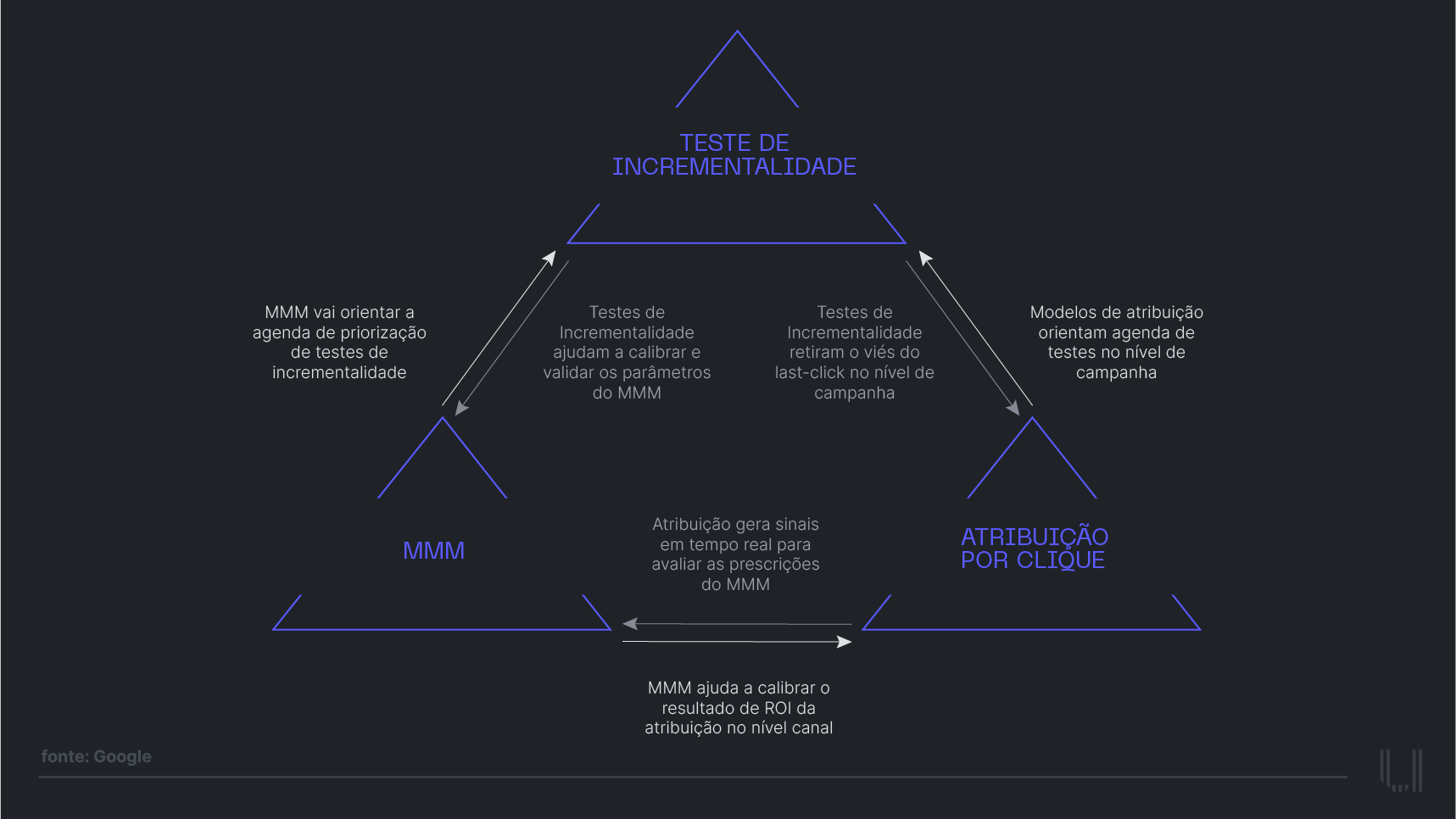
To achieve true ROI, certain MMM follow-ups are essential. It harmonizes very well with last-click attribution, which provides real-time feedback to adjust MMM recommendations, allowing for a more agile response to market dynamics. In addition, incrementality tests, guided by the MMM, are fundamental to calibrate and validate model parameters, removing last-click attribution bias. Thus, the combination of these methodologies offers a more complete and accurate analysis for an efficient allocation of marketing resources.
Conclusion
Now you know how to organize your project and place all the necessary ingredients on the table. If you need help implementing Marketing Mix Modeling in your company, don't hesitate to contact us. Uncover is a pioneer in Brazil in implementing high-frequency MMM.