

- The marginal ROAS assesses the additional revenue generated by an incremental investment in a media channel, as opposed to the average ROAS that observes the overall relationship between expenses and revenue.
- Each media channel has a saturation curve, representing how the channel's effectiveness decreases as investment increases and reaches the saturation point.
- Marginal ROAS is crucial for optimizing the effectiveness of marketing investments, helping to identify which media channel is generating the best return for the additional investment.
It's common in the marketing world to look at metrics such as cost per lead or cost per click to measure the effectiveness of our advertising investments. But there is a lesser-known, and extremely valuable, metric that must be taken into account when deciding on media investment: the marginal ROAS (Return on Advertising Investment). And that's what we're going to talk about in this article.
What is Marginal ROAS?
Marginal ROAS is a metric that shows us the amount of additional revenue that an incremental investment in a media channel is generating. It differs from the average ROAS because it focuses on the additional revenue earned with each incremental real spent on media, rather than looking at the overall relationship between expenses and revenue.
ROAS Medium: It measures the total return on investment in advertising over a period of time, considering all advertising spending and all the revenue generated. It's an aggregated metric that provides an overview of advertising performance.
Marginal ROAS: Analyzes the additional return generated by an incremental increase in advertising spending. This metric is fundamental to assess the impact of increasing or decreasing advertising investment, helping with the effective allocation of marketing budget.
And why is he so powerful? Because at a given moment the channels become saturated, and from then on, all investment in saturated media ceases to bring new consumers. The catwalk here is to look at the saturation curve and realize that, although a certain medium is bringing a higher total of leads, another channel may be providing the best additional return for each additional real invested.
- Also read: Introduction to Marketing Mix Modeling (MMM)
The Saturation Curve
And what is the saturation curve? Well, every media channel has a saturation curve. It represents the relationship between the amount of investment in a media channel and the amount of additional revenue that channel is generating. Basically, the effectiveness of a media channel will decrease over time, since effectiveness saturates as investment volume increases. The saturation logic varies from channel to channel.
To better understand, let's analyze two media channels: paid search (such as Google Ads) and TV.
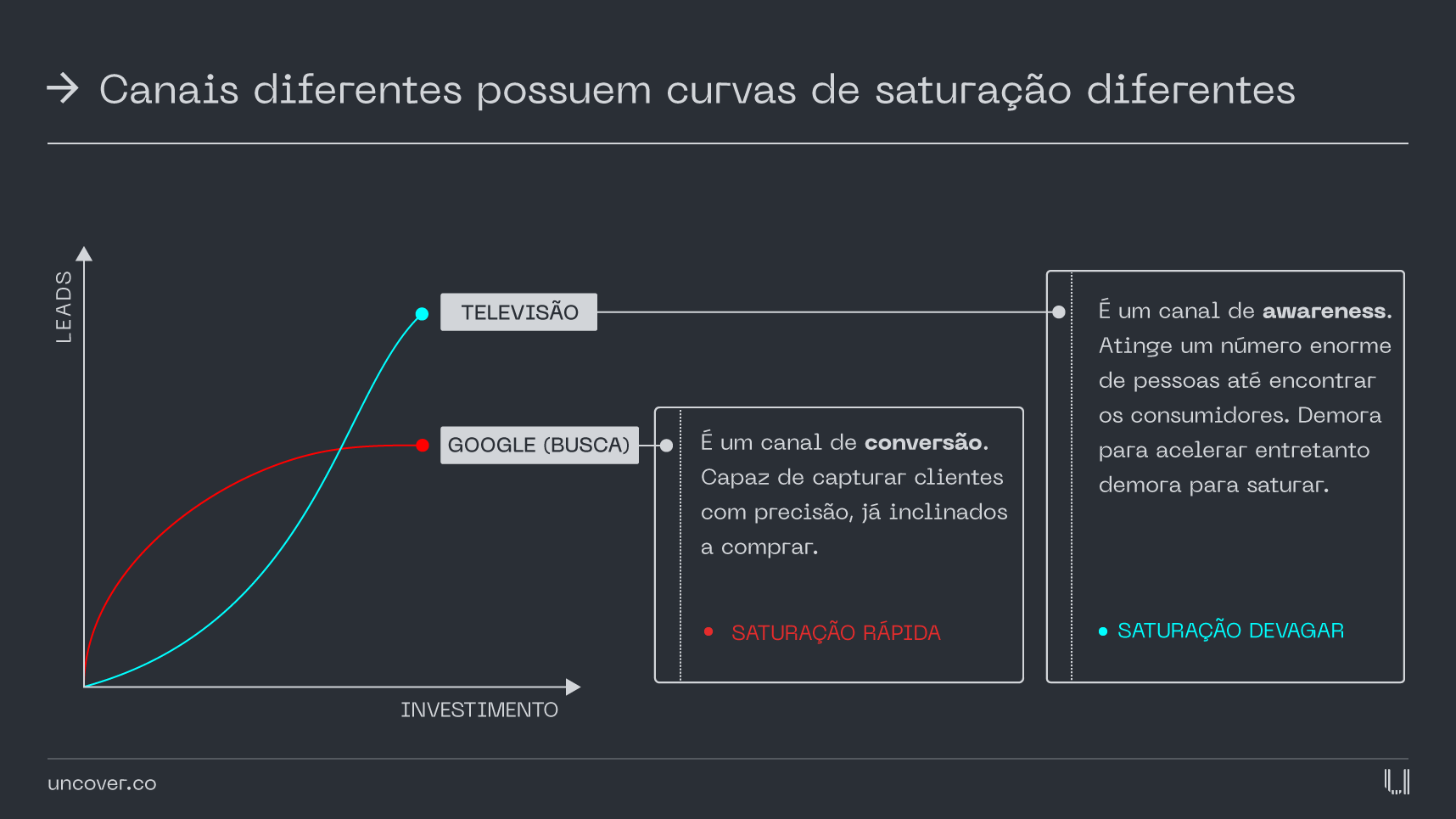
Paid search is effective for capturing people who are already interested in your brand or product, thus generating additional revenue quickly with a small investment. However, at some point, this effectiveness will diminish, since interest in your brand is not infinite.
TV, on the other hand, takes a different approach. It is more expensive for a smaller investment, as it needs to reach a large audience to find those who are interested in your product. However, the TV does not saturate as quickly as the paid search.
Suppose that, for a given investment volume, paid search has already reached its saturation point. Investing more in this channel would result in almost zero marginal ROAS, meaning it would not bring significant additional revenue. Meanwhile, on TV, the total ROAS may be lower, but the marginal ROAS is much higher, as it will continue to generate a significant volume of additional revenue.

Conclusion
Marginal ROAS is a crucial metric when deciding where to invest in media. It helps you identify which media channel is generating the best return for the additional investment, allowing you to optimize the effectiveness of your marketing investments. So the next time you're making a decision about where to invest in media, remember to consider ROAS marginal. This metric can make all the difference in the effectiveness of your marketing campaigns.